
🔥 Why AI will not send us home at noon, Update writing advice from C.S. Lewis, Tim Ferris on Self-Help Trap
#81: a weekly newsletter for building an incredible life & an antifragile mind.

Welcome to the 81st edition of the Antifragile 🔥.
This week, I go on a tangent about why AI will not send you home at noon (but who will).
Plus, some updated writing advice from C.S. Lewis and Tim Ferriss matches my trajectory away from self-help.
With love,
Chris
—
Here’s the Antifragile 🔥 this week:
Why AI Will Not Send Us Home at Noon: A Brief History of Technological Advances
(Updated) Writing Advice from C.S. Lewis
Tim Ferriss on the Self-Help Trap
1.) Why AI Will Not Send Us Home at Noon: A Brief History of Technological Advances
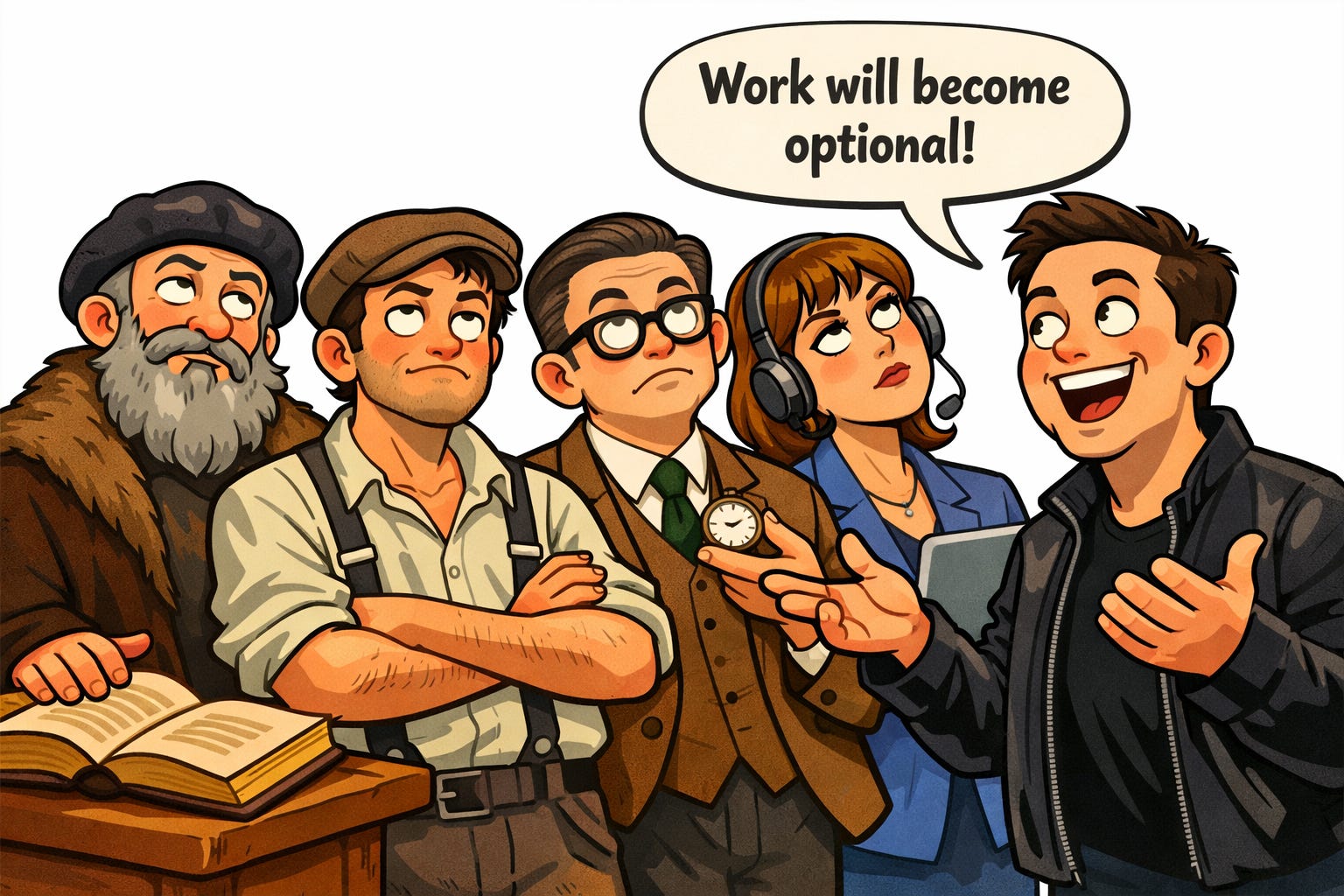
I found a couple of articles discussing how, despite the promises of staggering productivity gains—with Elon even predicting ”work will become optional” within 20 years—it seems that AI is actually turning up the pressure on workers rather than moving towards the all-you-can-play pickleball utopia we were sold.
“But what we’re finding is, the work that is out there, it seems unbounded,” he said. “It’s like the appetite is always to do more, not to, like, go home at noon.”
Mid-Size Tech Company CRO
It got me thinking: haven’t we seen this movie before?
Every major technological leap comes with the same promise—this will finally free us.
And every time, the results were the same:
The Printing Press (1400s–1600s) — “Knowledge will free us”
Promise: Books become abundant. Knowledge spreads. Learning gets easier. Less intellectual burden.
Reality: An explosion of information—more to read, process, argue about. Scholars and clergy didn’t relax—they were overwhelmed. The first wave of information overload.
Early Industrial Revolution (1700s–1800s) — “Machines will do the work”
Promise: Machines replace human labor. Work gets lighter. Hours shrink. Life improves.
Reality: Factories scale. Output expectations skyrocket. People work more hours, not less—often in harsher, more repetitive conditions. Productivity gains didn’t buy freedom. They raised the quota.
Late Industrial Age (1900s) — “We’ll work less and live more”
Promise: With compounding technological progress, economists (Keynes) predicted dramatically shorter workweeks. At one point, a 15-hour workweek by the early 21st century didn’t sound crazy.
Reality: Productivity explodes… and so do expectations. We don’t stop at “enough.” Extra capacity gets filled instantly.
The Internet (1990s–2000s) — “The paperless, frictionless office”
Promise: Faster communication. Less admin. Work becomes efficient, contained, maybe even… shorter.
Reality: Email, Slack, notifications. Work follows you everywhere. The office doesn’t disappear—it expands. There is no “off.” Only varying degrees of “on.”
And now…enter AI.
(Queue creepy generated applause)
Same promise. Same story. (Well—almost, more on that in a minute).
Faster writing 👉 more writing expected.
Faster coding 👉 more pushes expected.
Faster analysis 👉 more analysis expected.
Faster content creation 👉 more content.
Excess capacity 👉 opportunity for more profit.
It’s a feature for some, a bug for others (mainly the people doing the work).
This isn’t to say AI won’t result in amazing things, just as all of the above revolutions did.
But the reality is that in a capitalist society, technological advances don’t reduce work; they redefine what “enough” looks like.
Every increase in productivity resets the expectation baseline. And the machine that was supposed to take work off your plate simply made the plate bigger.
—
But it’s not all copy/paste from the past.
This time is different… but not in the way you think.
The difference isn’t the technology.
It’s our agency.
For the first time in history, a large percentage of people have real agency—the ability to shape their lives without the constant, looming threat of survival. We can step off the gas without risking our families falling into starvation.
We can tell the boss who just denied us a backfill hire “because you have AI” to shove it and find another job, or open a gluten-free creperie specializing in Harry Potter character-shaped crepes (my next career).
We can choose a smaller life, a slower life, a more intentional life.
That is new. And that sounds absolutely lovely.
But unfortunately, this does not happen by default. To the contrary.
The system, your instincts, and the tools will all keep pushing you toward more.
So if you want less…
you have to choose it.
You have to decide what “enough” looks like.
You have to say no when everything around you says yes.
You have to leave the plate partially full.
No machine will do that for you.
In fact, every machine you use will quietly push you in the opposite direction.
So if you don’t decide what “enough” is…it will be decided for you.
And you most certainly won’t be going home at noon.
2.) (Updated) Writing Advice from C.S. Lewis
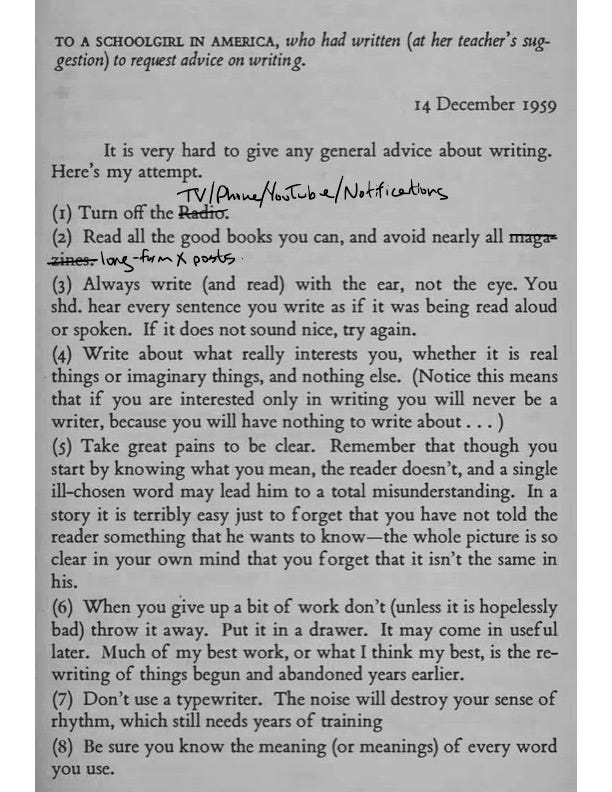
(Nearly) timeless advice from a writing legend.
3.) Tim Ferriss on the Self-Help Trap

Oh man, it has been a minute since I’ve talked about my guy Tim Ferriss.
But it seems like we’re on similar trajectories heading on a mild vector away from self-help. I enjoyed his post—The Self-Help Trap—and found a book he recommended—Already Free by Bruce Tift—to be a book I’ve been in search of for years.
Just one thing for you this week—
Opt out of more this week. Do good work…but also say, “No”. Step out of the flow.
With love,
Chris
—
Did this edition resonate with you? Sharing is caring. Send to a fellow antifragile dad.